Direct answer: Build a digital mixer assortment around distinct customer jobs. Define the sources, independent mixes, control workflow and support needs first; then compare documented DAM, MDX, T and MX candidates against the same brief. Give each selected SKU a clear role and verify its exact hardware, firmware and supplied configuration before approving a sample. Series names alone do not prove a feature or determine a price tier.
For professional-audio distributors, importers and integrators. A useful product range gives dealers a clear answer to “which customer is this for?” It also gives your technical team a manageable set of demonstrations, manuals and support cases. This guide shows how to build that range using DAM, MDX, T and MX as candidate families, without confusing a family name with a verified specification.
By Anthony Wu · ELEGAUDIO · November 20, 2026
Write down the recurring work your customers actually perform: a portable event setup, a resident venue system, a rental inventory or an installed system. These are planning scenarios, not declarations that a particular series automatically supports them. A small room can still need several independent monitor mixes; a larger event may place greater value on a familiar control surface than on an optional recording function.
For each job, separate physical sources from processing channels, and output connectors from independently controllable mixes. Record who operates the console, how often the setup changes and how the system should be restored after another operator uses it. Our digital mixer AUX, bus and DCA guide explains the routing terms behind this brief.
ELEGAUDIO lists DAM, MDX, T and MX among its digital mixer families. Model-specific capabilities must be checked against current documentation and the proposed sample. This article compares the decisions a distributor needs to make; it does not claim a laboratory performance ranking, a universal price ladder or identical features across a family.
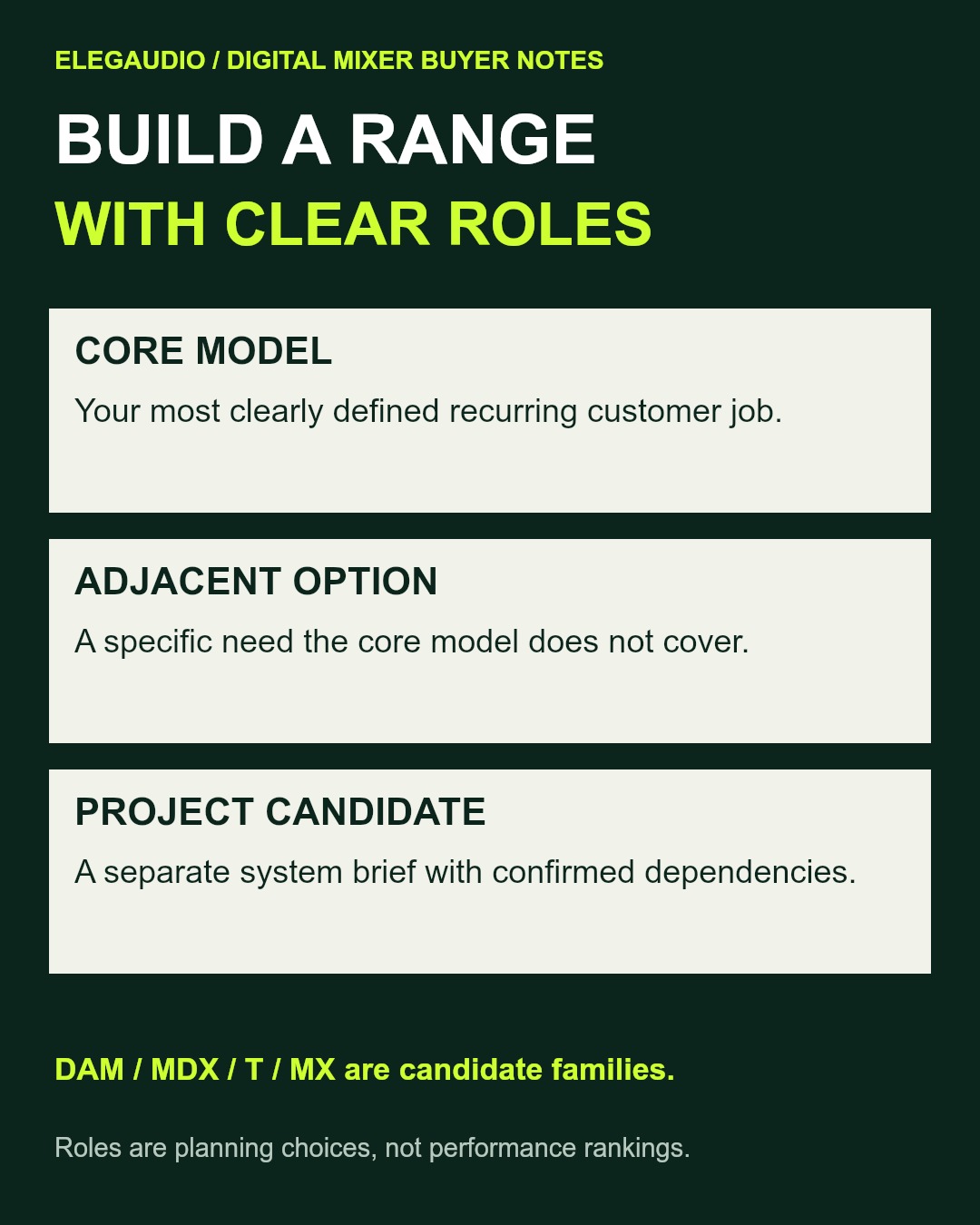
Assign roles by customer need; these are planning choices, not technical rankings.
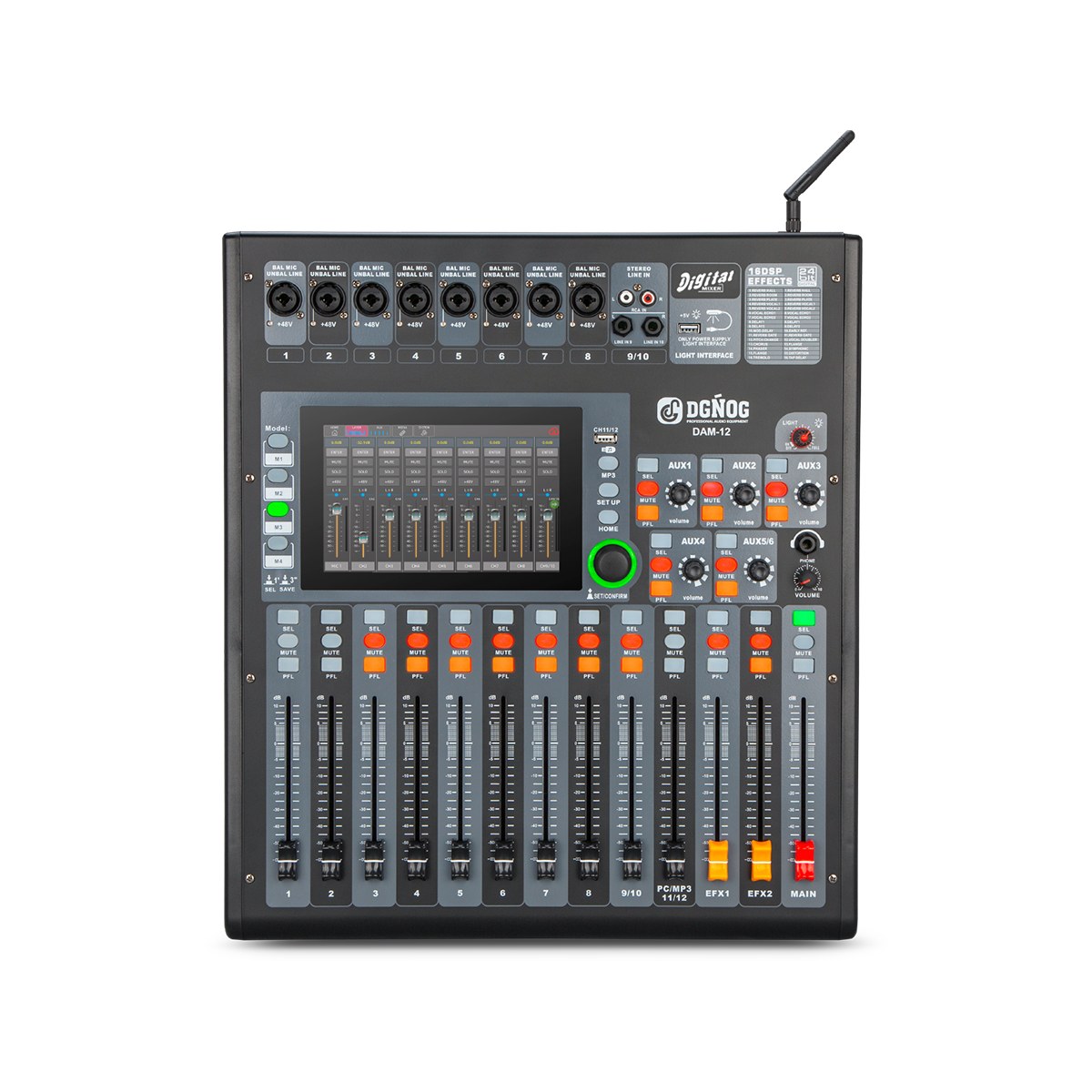
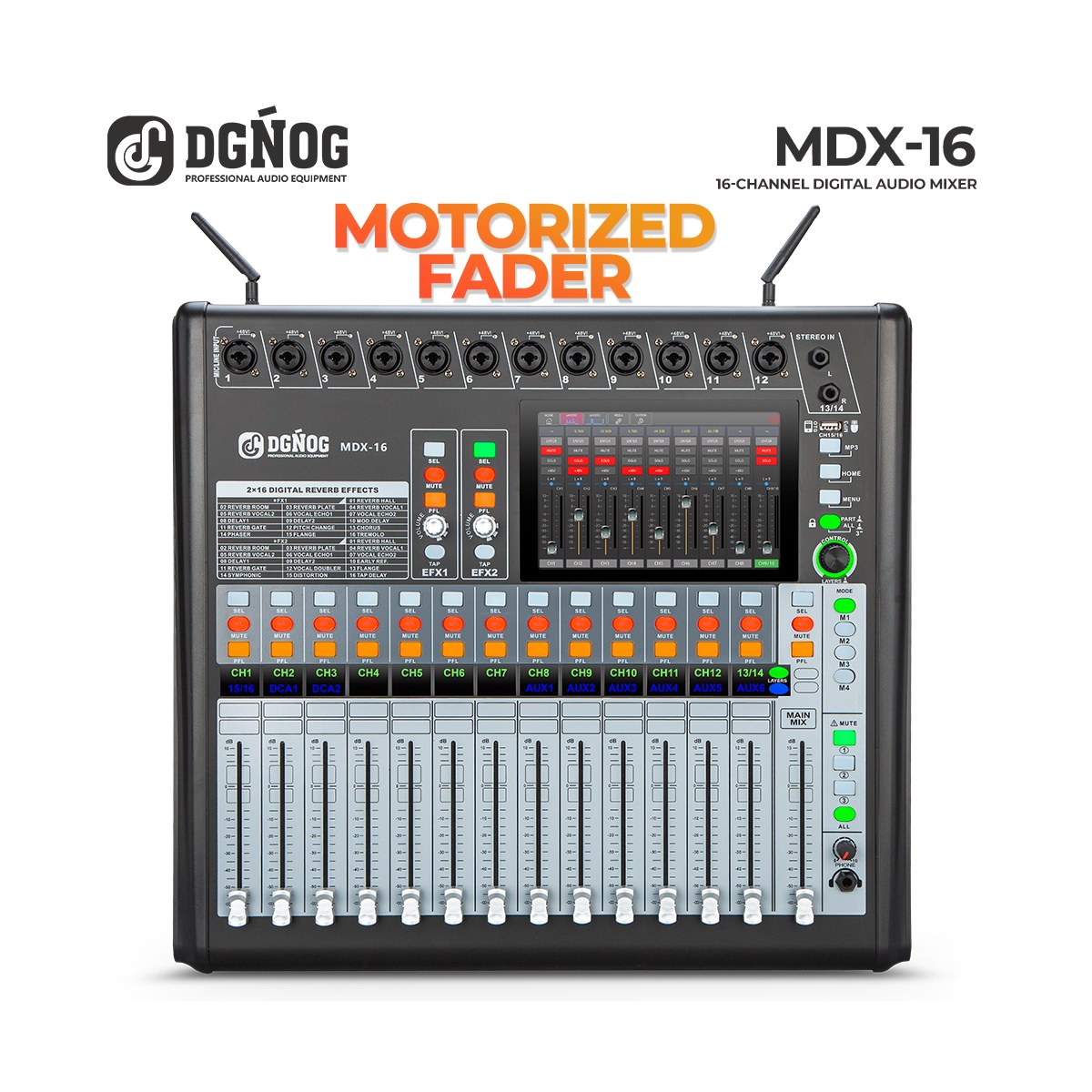
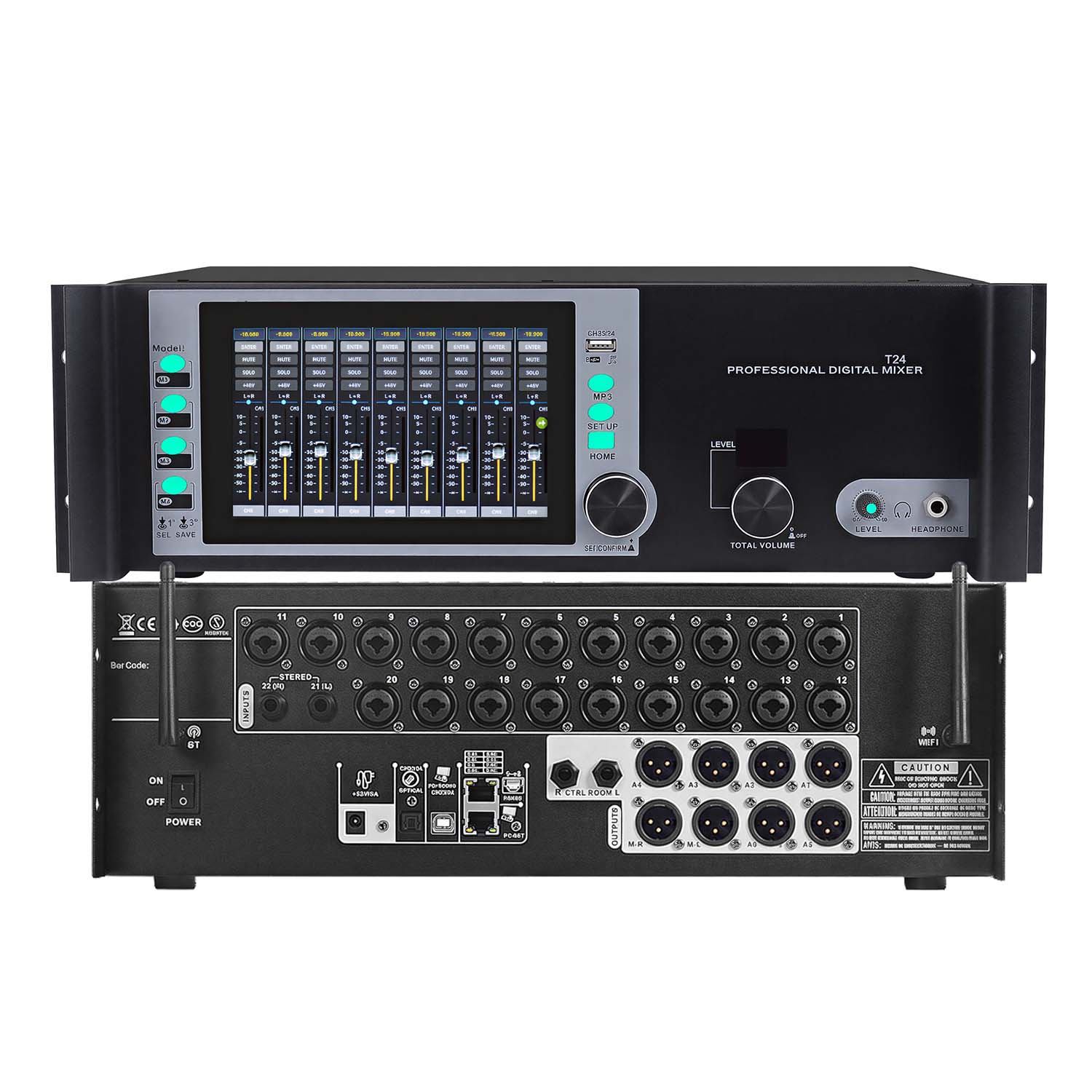
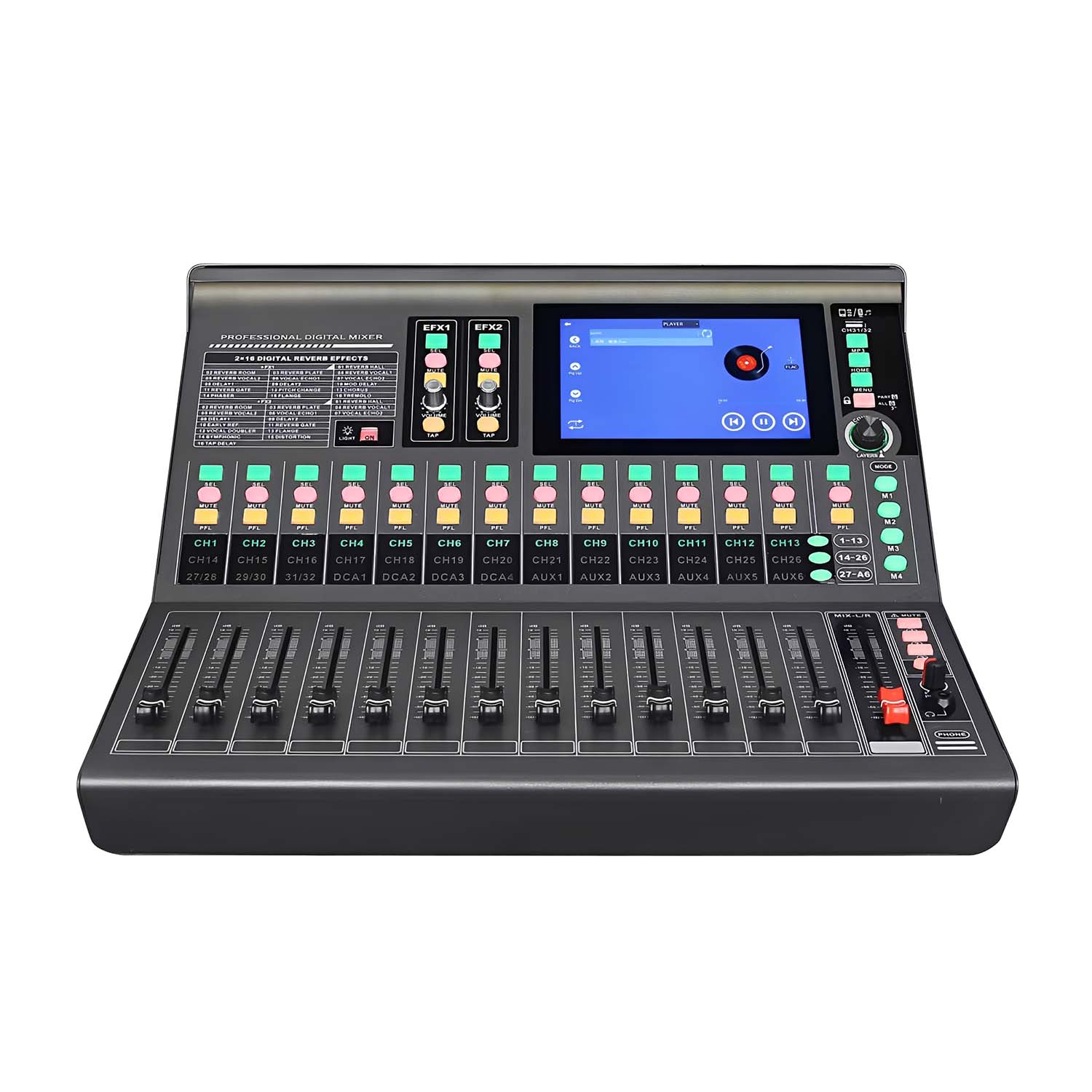
These official product photographs give a visual reference for each family. Open the linked model page and confirm the current version against your project brief.
Use the same questions for every proposed model. If an answer is missing, record it as not yet verified; do not convert it into either a confirmed capability or a confirmed weakness. Current project quotations are needed for price and commercial comparisons.
| Candidate family | Questions for the exact model | Workflow demonstration | Commercial and support evidence |
|---|---|---|---|
| DAM | Which current model meets the source list and required destinations? Confirm the supplied control surface and processing scope. | Trace one channel to the main mix and each required monitor destination. Check how the operator identifies the current settings. | Request the exact configuration, included accessories, current quotation and available operating documents. |
| MDX | Confirm current hardware/firmware, physical I/O and the control or recording functions required by the customer. | Demonstrate the proposed working method and any required scene/control changes on that exact version. | Check document coverage and whether training material matches each shortlisted model; do not assume family-wide interchangeability. |
| T | Match the intended signal flow to documented buses, outputs and control access. Identify any required external devices. | Walk through a representative setup, routing changes and the agreed recovery procedure. | Clarify the support contact, evidence required for a fault report and any project-specific integration scope. |
| MX | Confirm the specific model's source capacity, output needs, control layout and any required recording/control methods. | Test operator access to the necessary functions and the steps to save and restore the agreed setup. | Compare the complete quotation and available training, technical documents and after-sales responsibilities. |
How to read the table: these are evaluation prompts, not specifications. Do not assume that remote control, motorized faders, multitrack recording, expansion or a particular bus count is present on every listed model. Request evidence for each mandatory function. A missing document is a question to resolve, not a reason to invent a numerical score.
A distributor can start by defining roles and then finding evidence-backed models to fill them. The roles below are a planning framework. They do not assign DAM, MDX, T or MX to an unverified performance or margin tier.
| Assortment role | Reason to include it | Condition for approval |
|---|---|---|
| Core model | Covers the most clearly defined recurring customer job. | All mandatory requirements are documented and the sample demonstrates the agreed workflow. |
| Adjacent option | Solves a specific need the core model does not cover. | The difference is meaningful to a buyer and can be explained with evidence. |
| Project candidate | Addresses a less frequent installation, rental or integration requirement. | Project scope, support and system dependencies are confirmed before commitment. |
Example planning scenario: one dealer repeatedly serves portable events, while another needs a resident venue setup with several independent monitor feeds. Start with two separate requirement sheets. The result may be one model that meets both or two models with distinct roles. Do not decide from the room size or family name alone. No specific model capability or customer outcome is implied by this example.
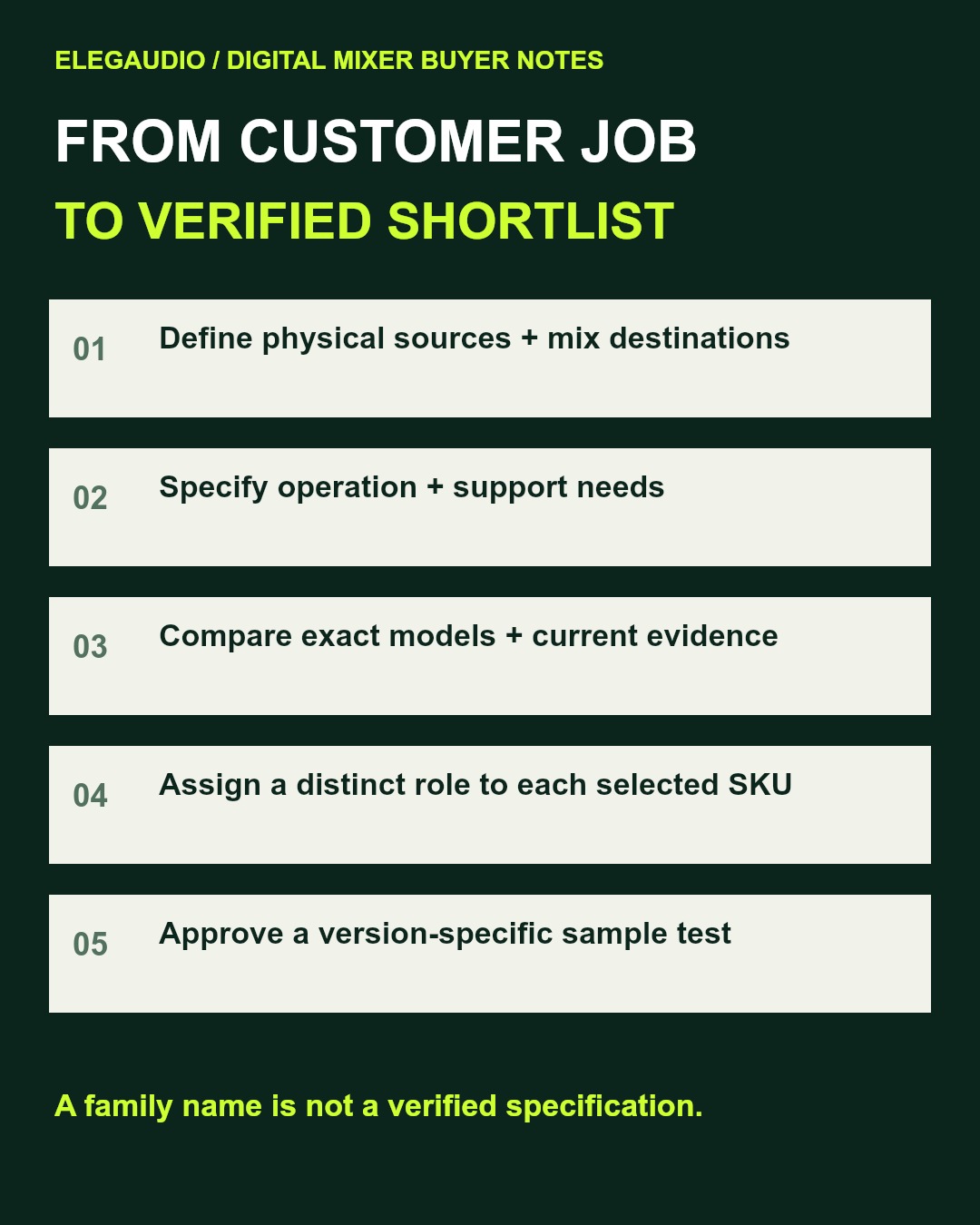
Keep the evidence reference for the exact proposed model and version.
Destination market / buyer type:
Three recurring customer applications:
Physical microphone, line and playback sources:
Main, monitor and other independent mix destinations:
Operator experience / required control workflow:
Recording or external-device requirements:
Core model role / candidate / evidence reference:
Adjacent role / specific unmet need / candidate:
Required manuals, training and after-sales scope:
Quantity, accessories, branding and quotation basis:
Mandatory gaps / responsible person / review date:
Sample setup / expected results / approval criteria:
Use this brief to request a shortlist from ELEGAUDIO. Our role includes product selection, sample evaluation, engineering verification, quality inspection, OEM/ODM coordination and export delivery. The proposed model, available service scope and project terms still need to be confirmed. For supplier accountability, see our separate eight-check digital mixer supplier guide.
Approve the sample against written requirements, preserve the hardware and firmware reference and record unresolved items. Use the digital mixer quality-control checklist to plan observable checks. A showroom demonstration is evidence only for the conditions demonstrated.
Start with the recurring customer application you can describe and support. Select one documented candidate that meets it, then add another only when it solves a different confirmed need. A series label is a starting point for evaluation, not proof that every model suits the application.
Do not infer physical input count, processing channels or independent monitor mixes from a model name. Request the current model-specific I/O list, routing information and manual, then verify the required setup on the sample.
Only if each selected model has a clear customer role and your team can support the range. A focused assortment may be easier to demonstrate and document; the right breadth depends on your actual customers, support resources and confirmed demand.
Align model revision, accessories, branding, packaging, documents, inspection, support and freight assumptions before comparing quotations. Request current project terms rather than assuming a series-wide price or MOQ.
Send the destination market, buyer type, recurring applications, required sources and destinations, operating workflow, quantity and support needs. Ask for the proposed exact models, current documentation and unresolved requirements before sample approval.
Send the completed brief to Yara and ask for a model-specific shortlist with current evidence.
Evidence basis: ELEGAUDIO's published digital mixer catalogue identifies the four families; the comparison above is a buyer planning framework. Confirm all technical and commercial statements in the current model proposal before ordering.
#DigitalMixers #DigitalMixerSelection #AudioDistribution #ProAudio #ELEGAUDIO #BuyerGuide