


Direct answer: Calculate digital mixer channels from the audio sources that must run at the same time. Count each mono source as one audio path and each left/right stereo source as two. Add required talkback and a clearly defined reserve, then check the proposed model's physical connectors, input-processing capacity and routing separately. The number of musicians or faders is not a reliable input count.
By Anthony Wu · ELEGAUDIO · November 21, 2026
The goal is a complete input worksheet that a band, rental team or distributor can use to compare exact consoles. A stage source, a socket, a processing channel, a fader and an output bus describe different parts of the signal path. A model name containing a number does not establish all of those capacities.
Start with the most demanding setup that must operate simultaneously. Where two acts share a console, record whether their equipment stays connected during changeover. Two sources can share a channel only when the real connection and routing plan allows it; do not subtract them merely because they are used in different songs.
Illustrative worksheet, not a universal band configuration or a model specification. The example assumes all listed feeds are connected and processed at the same time. The drum and vocal counts are chosen for this example; adapt them to the actual stage plan.
| Source group | Planned feeds | Mono-equivalent audio paths |
|---|---|---|
| Lead and backing vocals | 3 mono microphones | 3 |
| Drum microphones | 8 mono microphone feeds | 8 |
| Bass DI | 1 mono feed | 1 |
| Guitar microphone or DI | 1 mono feed | 1 |
| Stereo keyboard | Left + right | 2 |
| Stereo playback | Left + right | 2 |
| Show-source subtotal | All listed sources simultaneous | 17 |
| Operator talkback | 1 additional planned mono path | 1 |
| Reserved capacity | 2 spare paths, unused until needed | 2 |
| Planning target | 17 show sources + 1 talkback + 2 spares | 20 |
The worksheet totals 20 planned paths, not 20 currently active performers or a recommendation for a model labelled 20. With talkback in use and the two spares unused, this example has 18 active source paths. If every listed source is wired through a local analog input, plan for those connection needs and the reserve there; if a source enters by a documented digital path, record that route explicitly. Check any additional internal effect returns, USB returns or linked-channel rules separately in the proposed console's manual.
Example assumptions to confirm: the keyboard and playback are truly stereo, eight drum feeds are needed, the talkback routing meets the application, and the reserve can be reached and patched when required. A different band can need fewer or more paths.
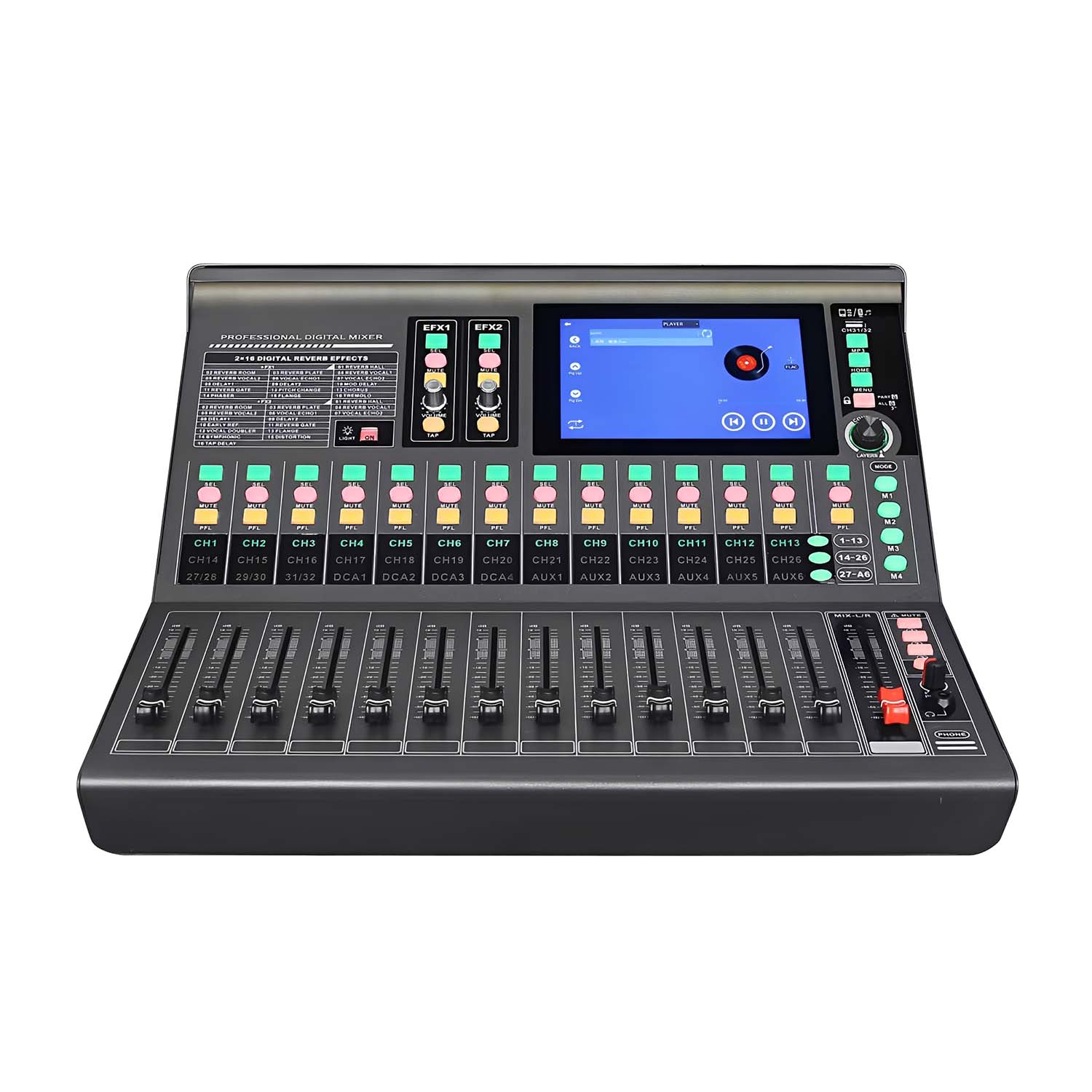
Use the official MX3210 model page as a starting point for a documented candidate review. The photo identifies the product; the example above does not prove this model supports that configuration. Confirm the current input map, version and routing before matching it to the worksheet.
Source ID / performer or device:
Feed name / mono or left-right pair:
Microphone / line / digital connection:
Physical port / required preamp or DI:
Processing channel / linked-pair rule:
Must operate simultaneously with:
Required main and monitor destinations:
Phantom-power requirement, where applicable:
Operational inputs / reserved paths:
Candidate model / hardware / firmware:
Manual reference / sample check / open question:
ELEGAUDIO supports product selection, sample evaluation, engineering verification, quality inspection, OEM/ODM coordination and export delivery. An explicit input list helps us discuss the actual requirement, identify missing evidence and compare exact candidates. Commercial scope and current model capabilities must be confirmed for the project.
No. A drummer may contribute several microphones, one keyboard can contribute two audio paths, and a musician may also need a vocal microphone. Build the source list rather than using musician count.
Not necessarily. A left/right source has two audio paths even when linked or presented on one stereo control. Check how the specific console counts and processes those paths.
No. Input processing and output mixes are different resources. An AUX output does not provide another input preamp or another independently processed source path.
Do not assume that. Check the exact model, USB direction, channel count, sample-rate conditions, routing and whether the required USB paths can operate simultaneously with the physical inputs.
Base the reserve on the expected additions and changeover workflow. Two spares are used in the example here, not a universal rule. List likely extra microphones, instruments or guest sources explicitly.
Send the input worksheet, simultaneous-use groups, destination market, required microphone and line connections, independent monitor mixes, recording/control needs and quantity. We can discuss a model-specific shortlist and the evidence needed before sample approval.
Send the source list and required destinations to Yara: yara@elegaudio.com or WhatsApp +86 136 3129 1403.
Continue with the digital mixer live-sound selection workflow, the AUX, bus and DCA guide, and the sample-to-shipment acceptance checklist.
#DigitalMixer #ChannelCount #BandInputList #LiveSound #ProAudio #ELEGAUDIO